
As organisations embrace AI and large language models, three concepts often surface in conversations about enterprise intelligence: semantic Indexes, the Microsoft Graph, and Work IQ. While they are related, each plays a distinct role in enabling AI-driven experiences. Understanding these differences is critical for leaders designing strategies for AI adoption.
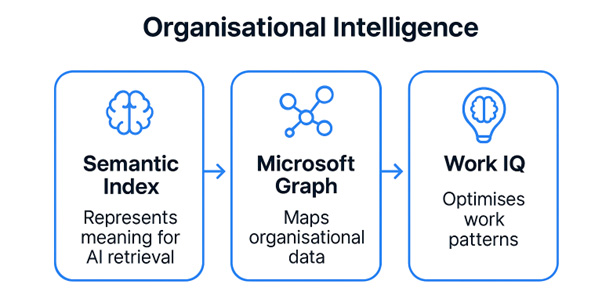
This diagram illustrates the three layers of organisational intelligence:
- Semantic Index
Represents meaning for AI retrieval - Microsoft Graph
Maps organisational data - Work IQ
Optimises work patterns
Semantic Indexes: The Foundation for AI Understanding
A semantic index is a structured representation of knowledge designed for meaning-based retrieval rather than keyword matching. Unlike traditional indexes that rely on exact text matches, semantic indexes use vector embeddings to capture the meaning of words, phrases, and documents. This allows AI systems and LLMs to retrieve information based on context and intent, not just literal text.
Why Semantic Indexes Matter for AI
- Contextual Search
Instead of searching for “budget report,” an LLM can find documents about “financial planning” because the semantic index understands the conceptual link. - Grounding AI Responses
Copilot and other enterprise AI tools rely on semantic indexes to provide relevant, permission-trimmed answers. - Personalisation
Semantic indexes can rank results based on user context, improving relevance.
Microsoft Graph: The Organisational Backbone
The Microsoft Graph is the unified API and data fabric for Microsoft 365. It maps the entities and relationships in your digital workplace—users, groups, files, meetings, chats, and more. Think of it as the connective tissue that links people, content, and activities across the organisation.
Key Capabilities include:
- Identity and Access
Who you are, what you can see, and what you can do. - Relationships
Who works with whom, what files are shared, what meetings occurred. - Signals
Activity patterns that inform recommendations and AI grounding.
The Graph is essential because it enforces security and compliance boundaries. When Copilot retrieves information, it uses Graph permissions to ensure users only see what they are authorised to access.
Work IQ: The Evolution of Microsoft Graph
Work IQ is Microsoft’s new term that builds on the Graph concept but goes further. While the Graph focuses on data and relationships, Work IQ introduces intelligence and interpretation: a layer that measures and optimises how work happens.
Work IQ is different to just the Microsoft Graph, in that it includes:
- Behavioural Insights
Work IQ looks at how effectively people use tools, collaborate, and adopt AI. - Contextual Intelligence
It doesn’t just connect data; it interprets patterns to improve productivity and decision-making. - AI Readiness
Work IQ is designed to help organisations understand their digital maturity and identify opportunities for improvement.
To summarise, the Graph answers “What exists and who can access it?”, Work IQ answers “How well are we using it to achieve outcomes?”.
Concept | Primary Role | AI Connection |
Semantic Index | Represents meaning for retrieval | Enables LLMs to find relevant content |
Microsoft Graph | Maps organisational entities and relationships | Provides secure, contextual data |
Work IQ | Measures and optimises work patterns | Guides adoption and effectiveness |
These components operate together. Semantic Indexes power AI reasoning. Microsoft Graph ensures secure, contextual access. Work IQ drives behavioural improvement and AI readiness.
As AI becomes embedded in workflows, success depends on more than technology. Leaders must:
- Build semantic indexes to make enterprise data AI-ready.
- Leverage Microsoft Graph for secure, context-aware experiences.
- Use Work IQ insights to improve adoption and maximise ROI.
The Intelligence Stack for Modern Work
Semantic indexes, Microsoft Graph, and Work IQ form a layered intelligence stack:
- Semantic understanding (what the data means),
- Contextual connectivity (how data and people relate),
- Behavioural optimisation (how work happens).
Organisations that master these layers will not only deploy AI, they will transform work itself.