
Artificial Intelligence has rapidly evolved from a futuristic concept to a practical tool reshaping organisations and industries. Yet, when organisations first explore AI, the most common starting point is individual productivity improvements. These can include meeting automation, content creation, or repetitive tasks automation. While these initiatives deliver quick wins, they represent only a basic first step in a transformative use of AI.
To unlock AI’s full potential, businesses must think beyond incremental efficiencies and embrace strategies that infuse AI into existing products and services and create entirely new offerings to bring to market. These approaches not only differentiate organisations but also position them as innovators in an increasingly competitive landscape.
Here we explore three distinct AI implementation paths.
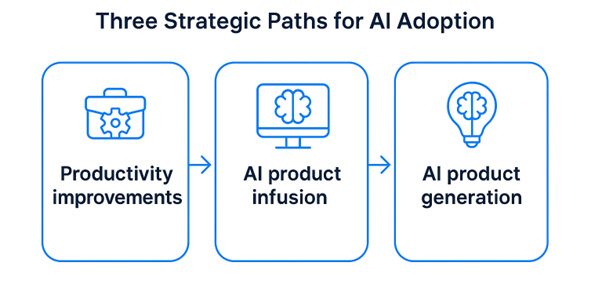
Productivity Improvements: The Low-Hanging Fruit
When executives first consider AI, the conversation often revolves around efficiency. Can AI help employees work faster? Can it automate routine tasks? The answer is almost always yes. Examples include:
- Automating data entry and reconciliations
- Generating meeting summaries and action items
- Drafting emails or reports using generative AI
- Enhancing search capabilities across enterprise data
These solutions are attractive because they are easy to implement, require minimal change management, and deliver immediate ROI.
However, the reality is that these improvements rarely transform the business model. They optimise existing processes but do not create new revenue streams or competitive advantages.
Productivity improvements deliver benefits quickly:
- Low risk
Productivity tools are non-disruptive and easy to pilot. - Quick wins
They demonstrate tangible benefits early, which helps justify further investment. - Vendor-driven
Many enterprise software providers bundle AI features into existing platforms, making adoption seamless.
While these benefits are real, they should serve as a launchpad, not the destination. The real value of AI emerges when businesses embed intelligence into their offerings.
Infusing AI into Existing Products and Services
The second, and more strategic approach, is to enhance current products and services with AI capabilities. This moves AI from the back office to the customer experience, creating differentiation and added value.
These enhancements deepen customer engagement and strengthen loyalty. They also allow organisations to command premium pricing by offering smarter, more intuitive solutions.
Infusing AI into existing offerings is transformational because it shifts the conversation from internal efficiency to customer value creation. It signals that the organisation is not just adopting AI, it is reimagining its value proposition.
Developing New AI-Powered Products and Services
The most ambitious and potentially rewarding path is to create entirely new products and services built on AI capabilities. This is where true innovation happens.
These innovations often require significant investment, cross-functional collaboration, and a willingness to disrupt existing models. But they also open doors to new markets, new revenue streams, and industry leadership.
Strategic Advantages of this approach include:
- First-mover benefits
Early adopters can capture market share before competitors catch up. - Brand positioning
AI-driven products signal innovation and attract tech-savvy customers. - Long-term growth
Unlike productivity tools, new offerings can scale globally and evolve continuously.
Developing new AI-powered products is not without challenges. Data quality, ethical considerations, and talent acquisition are critical hurdles to overcome. Yet, for organisations willing to invest, the payoff can be exponential.
But Productivity is still important
It’s tempting to dismiss productivity improvements as trivial, but they play a role in the AI journey. They:
- Build organisational confidence in AI
- Demonstrate tangible benefits quickly
- Lay the foundation for more complex initiatives
The danger lies in stopping there. Organisations that limit AI to internal efficiencies risk falling behind competitors who leverage AI for customer-facing innovation and market disruption.
A Strategic Roadmap for AI Adoption
To maximise AI’s potential, organisations should adopt a tiered approach:
- Start with productivity improvements to gain momentum and validate ROI.
- Progress to infusing AI into existing offerings, enhancing customer experience and differentiation.
- Invest in creating new AI-powered products, positioning the business as an innovator and market leader.
This roadmap ensures that AI adoption is not a series of disconnected experiments, but a strategic evolution aligned with business goals.